
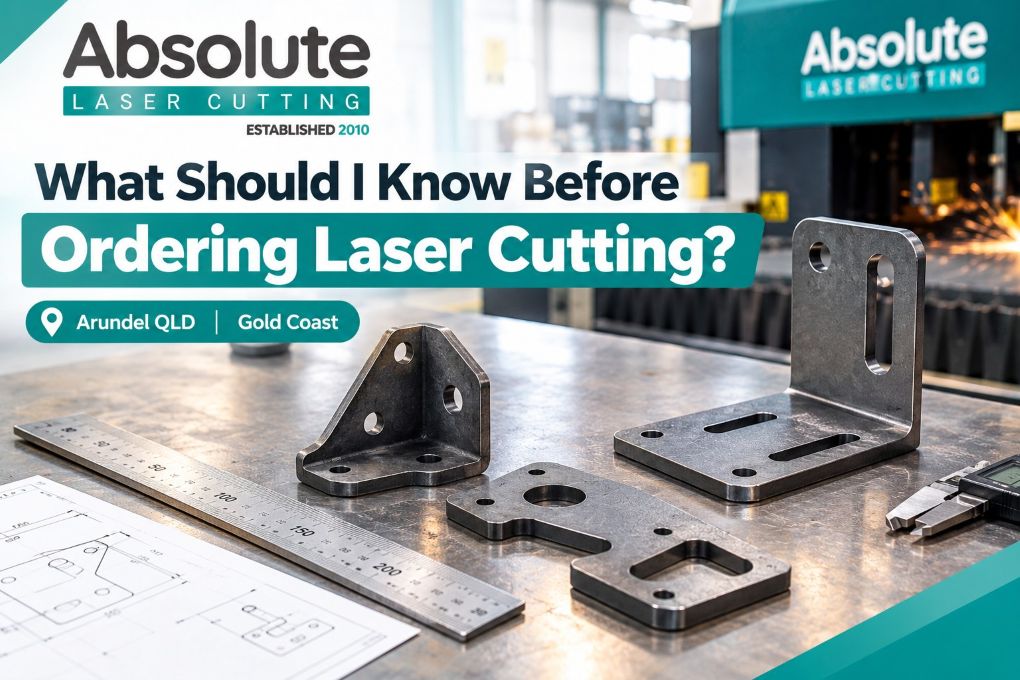
Knowing what to prepare before ordering laser cutting saves time, prevents rework, and gets your parts right the first time. Whether you are placing your first order or sourcing from a new service, this guide covers everything you need to have sorted before you send a file or pick up the phone.
Why Preparation Makes or Breaks a Laser Cutting Order
Most delays, extra costs, and rework on laser cutting jobs come from the same small set of problems: wrong material specified, file not ready, thickness outside the optimal range, or tolerance expectation not communicated upfront. None of these are difficult to get right. They just need to be thought through before the order is placed.
A well-prepared order gets quoted faster, goes into production sooner, and comes back with parts that fit and are ready to use. An under-prepared order generates back-and-forth that adds days and sometimes costs money to resolve.
Here is what a prepared order looks like versus one that is not:
| Element | Prepared Order | Unprepared Order |
| Material | Specified with grade, e.g. 316 stainless, MS350 | “Steel” or “metal” |
| Thickness | Confirmed and within range | Unknown or assumed |
| File | DXF ready, or reference drawing provided | Nothing submitted yet |
| Quantity | Confirmed | Rough estimate or range |
| Tolerance | Known and communicated | Not considered |
| Turnaround | Stated upfront | Assumed immediate |
Running through each of these before contacting a laser cutting service is the single most effective thing you can do to get a fast, accurate quote and a smooth job.
What You Need to Know About Laser Cutting Materials
The first thing to lock in before ordering laser cutting is your material. Not just the metal type, but the grade and alloy. This matters more than most first-time buyers expect.
The Most Common Industrial Metals for Laser Cutting
- Mild steel (MS250 and MS350): The most widely used and most cost-effective. Right for structural brackets, frames, general fabrication, and most Gold Coast construction and engineering work.
- Stainless steel 304: General purpose stainless, used for food grade, architectural, and interior applications where appearance matters.
- Stainless steel 316: Marine and coastal grade. Essential for Gold Coast and Queensland applications near salt water.
- Aluminium 5052: General fabrication aluminium, good for forming and welding.
- Aluminium 6061: Structural engineering grade, harder and stronger than 5052, used for load-bearing components and machinery parts.
- Galvanised steel and Zincalume: For outdoor, agricultural, and rural applications where corrosion resistance is built into the base sheet.
- AR400 and Hardox wear plate: For mining, earthmoving, and heavy industry where surface hardness matters as much as cut accuracy.
Materials That Cannot Be Laser Cut
Not every material is suitable for laser cutting. The following should never be laser cut:
- PVC and vinyl: releases chlorine gas when laser cut, hazardous and corrosive
- Polycarbonate and Lexan: absorbs the beam inefficiently, melts and discolours
- Carbon fibre and fibreglass: releases toxic fumes during cutting
- Any material with unknown composition: always confirm suitability before ordering
If you are unsure whether your material is suitable, contact the service before sending a file. A professional laser cutting service will confirm suitability before cutting anything.
Laser Cutting Thickness: Know Your Limits Before You Design
Laser cutting thickness has a direct effect on cost, accuracy, and whether laser is even the right process for your job. Every material has a maximum thickness that laser cutting handles well. Beyond that maximum, edge quality drops and a different process like plasma cutting becomes more appropriate.
Practical thickness reference:
| Material | Optimal Range | Maximum for Laser |
| Mild Steel | 1mm to 12mm | 20mm |
| Stainless Steel 304 | 1mm to 8mm | 12mm |
| Stainless Steel 316 | 1mm to 6mm | 12mm |
| Aluminium 5052 and 6061 | 1mm to 6mm | 10mm |
| Galvanised / Zincalume | 0.5mm to 2mm | 3mm |
| AR400 / Hardox | 3mm to 12mm | 20mm |
The key thing to know: optimal range is where you get the best combination of speed, edge quality, and cost. You can technically cut outside this range in most cases, but cost goes up and edge quality can be affected above 16mm on mild steel and above 10mm on stainless.
Design your parts at the minimum thickness that meets your structural requirement. Thicker costs more to cut and more in raw material. If you are not sure what thickness you need, most laser cutting services can advise before you commit.
Laser Cutting File Requirements: What to Send
Getting the file right is the single biggest thing you can do to speed up your order and avoid errors. Laser cutting is a CNC process. The machine follows the file exactly, which means a file error becomes a part error.
The Best File Format for Laser Cutting
- DXF (Drawing Exchange Format): The industry standard for laser cutting. Vector-based, scale-accurate, and directly machine-readable. If your engineer or draftsperson has produced a CAD drawing, export it as DXF before sending.
- DWG: AutoCAD native format, also accepted by most services with in-house CAD capability.
- PDF with accurate dimensions: Acceptable at services with in-house CAD support who convert to DXF before programming.
File checklist before sending:
- Confirm all dimensions are to scale, not “fit to page”
- Check that all cut lines are vector paths, not raster images
- Remove any layers, annotations, or dimensions that are not part of the cut geometry
- Confirm the file units match your intended dimensions (mm is standard in Australia)
- Check that internal holes and cutouts are closed paths, not open lines
What If You Do Not Have a DXF File?
Most first-time buyers and tradies do not have machine-ready CAD files. That is not a problem at a service with in-house CAD support. Absolute Laser Cutting accepts:
- PDF drawings with clear dimensions
- Hand sketches with measurements written on them
- Photos of existing parts or worn originals that need duplicating
- Rough dimension lists with a description of what you need
The in-house CAD team converts your reference material to a cut-ready DXF file as part of the job at no extra charge for standard file preparation. The only thing to avoid is sending a reference with unclear or missing dimensions. If the CAD team cannot determine a dimension with certainty, they will contact you before cutting rather than guess.
Laser Cutting Tolerances: What Accuracy to Expect
Laser cutting tolerance is the dimensional accuracy you can expect across a batch of parts cut from the same file. Understanding tolerance before you order helps you design parts correctly and avoid discovering a fitment problem after the job is done.
Industrial fibre laser cutting holds the following tolerances:
| Thickness Range | Typical Tolerance | Suitable For |
| 0.5mm to 3mm | +/-0.05mm | Intricate parts, fine detail, precision assemblies |
| 3mm to 8mm | +/-0.1mm | Standard engineering, fabrication, structural work |
| 8mm to 15mm | +/-0.1mm to +/-0.2mm | Structural applications, frames, brackets |
| 15mm to 20mm | +/-0.2mm to +/-0.3mm | Heavy structural work, less precision-critical jobs |
What this means when designing parts:
- If parts need to assemble with another component, design to +/-0.1mm and keep your material under 12mm
- If you are welding parts together and some fitment adjustment is fine, +/-0.2mm on thicker material is generally acceptable
- If your design has tight tolerances specified by an engineer, confirm the material thickness range before ordering
At Absolute Laser Cutting, standard tolerance across all jobs is +/-0.1mm, maintained consistently across production runs for material up to 12mm.
How Laser Cutting Cost Is Calculated
Laser cutting cost is not a fixed price per metre or per sheet. It is calculated from several variables that interact with each other. Understanding these helps you estimate cost before requesting a quote and identify where savings are possible.
The main cost drivers:
- Material type and grade: Mild steel is the most economical. Stainless steel costs more due to material price and slower cutting speed. Aluminium sits in between depending on alloy.
- Material thickness: Thicker material cuts slower, increasing machine time and therefore cost per part.
- Cut path complexity: More cuts, more intricate geometry, and more small holes mean more machine time. A decorative screen with 200 cutouts costs more to cut than a simple bracket of the same size.
- Quantity: Setup cost is fixed per job regardless of quantity. More parts spread that cost further, reducing price per part on larger runs.
- Nesting efficiency: Parts that pack tightly on a sheet waste less material and cost less per part than irregular shapes with low nesting efficiency.
- Turnaround: Standard lead time is the most economical option. Express or 24-hour service may carry a premium.
Quick cost guide by thickness:
| Thickness | Machine Time | Cost Impact |
| Under 3mm | Low | Most economical |
| 3mm to 10mm | Moderate | Standard rates |
| 10mm to 16mm | Higher | Noticeably more per part |
| 16mm to 20mm | High | Consider plasma for non-precision work |
Pricing at Absolute Laser Cutting starts from a minimum order of $50. Same-day itemised quotes are available for jobs submitted with a file or drawing before 2pm.
Laser Cutting Turnaround Time: What Is Realistic?
Knowing what turnaround to expect helps you plan your project timeline and avoid the mistake of assuming laser cutting is always same-day. It is fast, but it is not instant unless you book an express service.
Standard turnaround benchmarks:
| Service Level | Turnaround | When to Use |
| Same-day quote | Before 2pm submission | Always, for planning purposes |
| Standard production | 3 to 4 business days | Most jobs, most budgets |
| 24-hour express | Confirmed and available | Urgent jobs, breakdowns, tight site deadlines |
Things that affect turnaround:
- File issues that need resolving before cutting starts
- Material not in stock for unusual grades
- Large quantity orders that require multiple production runs
- Express queue availability on the day
The most reliable way to hit a deadline is to submit your job with a complete file and confirmed material specification as early as possible. A same-day quote before 2pm at Absolute Laser Cutting means standard jobs can often start the same or next business day.
How to Read a Laser Cutting Quote
A laser cutting quote tells you more than just the price. How a service writes its quote tells you how transparently it operates. Here is what a good quote includes and what to watch out for.
What a good itemised quote shows:
- Material type, grade, and thickness
- Quantity and per-part price
- Machine time or cutting cost
- Setup or programming fee, or confirmation there is none
- Any finishing costs such as deburring, bending, or coating
- Freight or pickup options
- Lead time confirmed
Red flags in a quote:
- A single total with no breakdown
- A price given before the service has reviewed your file
- Setup fees that were not mentioned when you first enquired
- No confirmed lead time, just “we will let you know”
- A minimum order that was not disclosed upfront
At Absolute Laser Cutting, quotes are itemised, transparent, and same-day for most standard jobs. No hidden fees. Pricing starts from $50.
Common Mistakes First-Time Buyers Make
These come up regularly and are all avoidable with a small amount of preparation:
- Specifying “steel” without a grade: MS250, MS350, 304 stainless, and 316 stainless are different materials with different prices and properties. Always specify the grade.
- Sending a PDF at the wrong scale: “Fit to page” when printing or exporting changes the dimensions. Always confirm dimensions are to scale before sending.
- Designing parts too thick: A part at 20mm mild steel costs significantly more than the same part at 12mm. If structural requirements allow it, design thinner.
- Not confirming tolerance requirements: If a part needs to fit precisely with another component, state the tolerance requirement upfront.
- Leaving the turnaround conversation too late: If you have a site deadline, mention it when you enquire. Express service needs to be booked, not assumed.
- Not asking about CAD support: Many buyers give up because they think they need a DXF file. Most good laser cutting services can work from a sketch or photo.
What to Have Ready Before You Contact a Laser Cutting Service
Use this checklist before making contact. The more of this you have confirmed, the faster and more accurate your quote will be.
Material:
- Material type (mild steel, stainless, aluminium, etc.)
- Grade or alloy (MS350, 316 stainless, 6061 aluminium, etc.)
- Thickness in mm
Geometry:
- DXF or DWG file, or PDF drawing with dimensions, or sketch with measurements
- If duplicating a part, a photo of the original with a ruler in frame
Order details:
- Quantity required
- Any finishing requirements such as deburring, bending, or powder coat prep
- Required turnaround, standard or express
Application context (helpful but not essential):
- What the part is for and how it assembles with other components
- Any tolerance requirements tighter than +/-0.1mm
- Whether the part will be welded, bolted, or installed directly
Why Absolute Laser Cutting Makes Ordering Simple
Absolute Laser Cutting has operated from Arundel, Gold Coast since 2010. Here is how the service removes every common friction point from the ordering process.
No file? Not a problem. The in-house CAD team works from PDFs, sketches, photos, and rough dimension lists. No CAD experience required to place an order.
Same-day quote. Submit before 2pm with your material details and reference drawing. Get an itemised quote back the same day.
No minimum order headaches. Pricing starts from $50. Single prototype parts, replacement parts, and production runs of 500 are all equally welcome.
Transparent pricing. Itemised quotes with no hidden setup fees and no charges that appear at invoice that were not in the quote.
Confirmed 24-hour express. Not a theoretical option. Genuinely available for urgent and breakdown jobs.
Full material range. Mild steel to 20mm, stainless 304 and 316 to 12mm, aluminium 5052 and 6061 to 10mm, galvanised steel, Zincalume, AR400, and Hardox. Maximum sheet size 3000mm x 1500mm.
Standard tolerance: +/-0.1mm, consistent across every part in a production run.
Frequently Asked Questions
What information do I need before ordering laser cutting?
You need your material type and grade, thickness, quantity, a file or drawing, any finishing requirements, and your required turnaround. The more complete this is upfront, the faster and more accurate your quote will be.
What file format does laser cutting use?
DXF is the industry standard. DWG is also accepted. A service with in-house CAD support can also work from PDFs, sketches, and photos, converting them to cut-ready files at no extra charge.
What is the minimum order for laser cutting in Australia?
Most services apply a minimum order to cover setup costs. At Absolute Laser Cutting, pricing starts from $50, making single parts and small jobs as accessible as large production runs.
How accurate is laser cutting?
Industrial fibre laser cutting holds +/-0.1mm dimensional tolerance consistently across a full production run for material up to 12mm. Above 12mm, tolerance may widen slightly to +/-0.2mm.
How long does a laser cutting order take in Australia?
Standard turnaround at a well-run service is 3 to 4 business days from quote approval. Confirmed 24-hour express is available at Absolute Laser Cutting for urgent jobs.
What is the difference between custom and standard laser cutting?
Custom laser cutting means cutting parts to your specific design rather than a stock product. All laser cutting at Absolute Laser Cutting is custom. Every job is cut to your file or drawing.
Ready to Place Your First Laser Cutting Order?
Absolute Laser Cutting has been making ordering laser cutting services simple for Gold Coast and Queensland businesses since 2010. Send a file, sketch, photo, or PDF before 2pm and get a same-day itemised quote. No minimum order headaches. No hidden fees. Pricing from $50.