 Skip to content

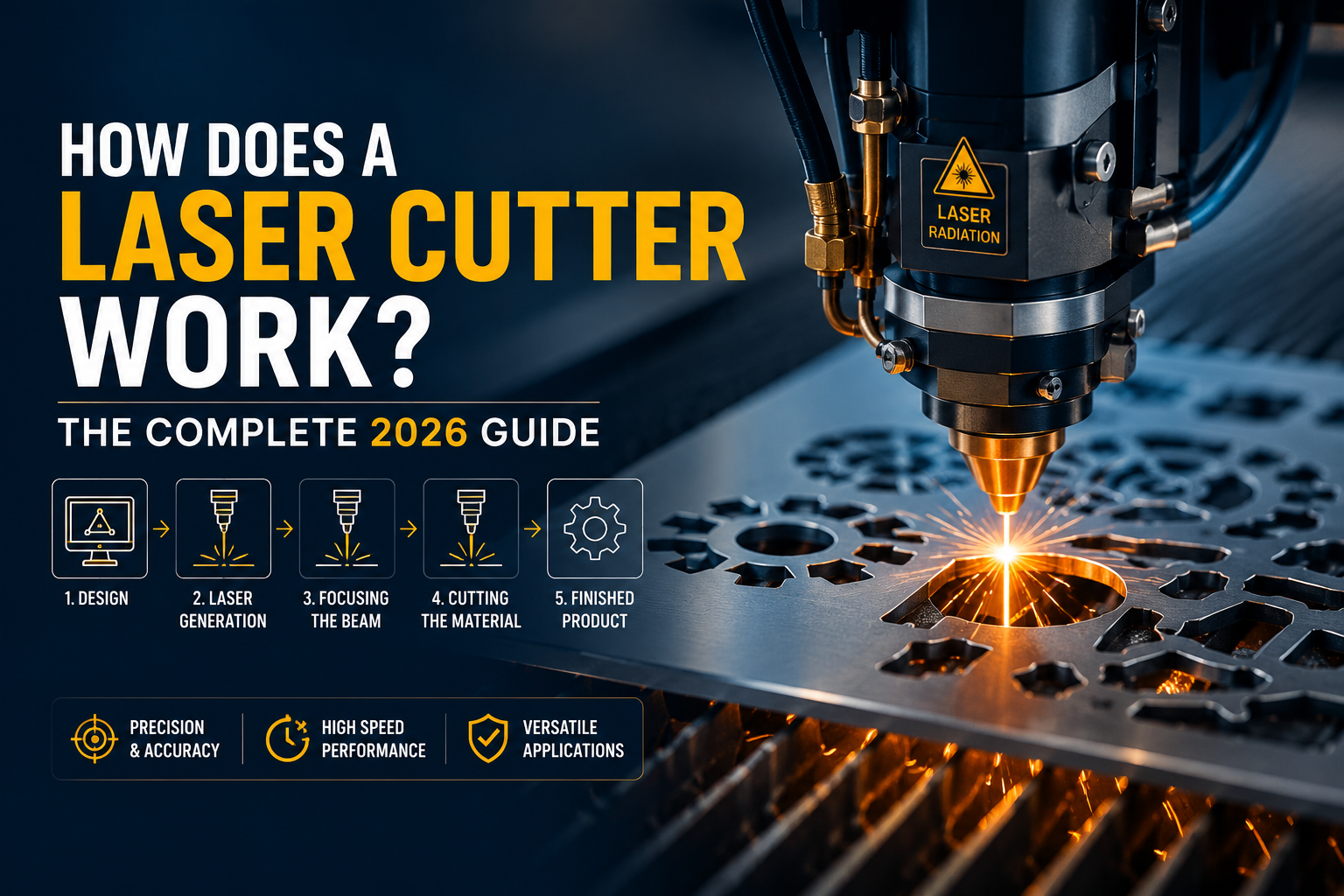
Understanding how does a laser cutter work gives you a practical edge, whether you’re a fabricator, engineer, tradie, or business owner trying to understand what you’re actually paying for. The short answer is a focused beam of light melts or vaporises metal along a programmed path with CNC precision. The longer answer explains why that process produces results that manual cutting, plasma, and waterjet simply cannot match consistently. This guide covers all of it in plain language.
What Is a Laser Cutter?
A laser cutter is a CNC-controlled machine that uses a focused, high-intensity beam of light to cut through materials with exceptional precision. The word LASER stands for Light Amplification by Stimulated Emission of Radiation, which describes how the beam is generated and amplified before it ever touches the material.
Unlike mechanical cutting tools that physically contact the workpiece and wear down over time, a laser cutter is a non-contact process. The beam does the work, which means:
- No tool wear affecting cut quality over time
- No mechanical force distorting thin or delicate materials
- Consistent accuracy from the first part to the five hundredth
- Intricate geometries and tight internal radii that physical tools simply cannot produce
In industrial settings across Australia, laser cutters are the standard for sheet metal cutting in steel, stainless steel, and aluminium, producing parts for construction, engineering, mining, agriculture, architecture, and manufacturing. Absolute Laser Cutting operates this technology from its purpose-built facility in Arundel, Gold Coast, servicing industries across South East Queensland every day.
How Does a Laser Cutter Work? The Full Process Explained
Here is the complete process from design file to finished cut part, explained in the sequence it actually happens.
Step 1: The Design File
Everything starts with a DXF or DWG file created in CAD software. At Absolute Laser Cutting, the in-house CAD team converts PDFs, sketches, and photos to cut-ready files at no extra charge, so clients don’t need to arrive with a machine-ready file.
Step 2: Nesting and Programming
Parts are nested on the sheet using nesting software to minimise wasted material and reduce cost per part. The layout is converted into machine code (G-code) that tells the CNC system where to move, at what speed, and with what power settings.
Step 3: The Laser Beam Is Generated
In a fibre laser, semiconductor diodes generate light amplified through a fibre-optic cable into a high-intensity cutting beam. In a CO2 laser, electrical energy excites a gas mixture, producing the beam via a series of mirrors.
Step 4: The Beam Cuts the Material
A focusing lens concentrates the beam to less than 0.1mm at the focal point. The beam hits the metal surface, rapidly melting or vaporising it along the cut path. An assist gas blows through the nozzle, clearing molten material from the kerf and producing a clean edge.
Step 5: Parts Are Checked and Dispatched
Parts are removed from the sheet skeleton, checked for accuracy, and prepared for pickup or dispatch. On standard cuts, edges come off the machine weld-ready with no secondary finishing required.
How Does a CO2 Laser Cutter Work vs a Fibre Laser?
This is the most important technical distinction for anyone sourcing industrial laser cutting in Australia. The two technologies produce different results on metal, and knowing which one a service operates tells you a lot about what to expect.
How a CO2 laser cutter works:
A sealed glass tube filled with carbon dioxide and nitrogen gas is energised by high voltage. This excites the gas molecules and produces a laser beam at a wavelength of around 10 microns. The beam is directed through a series of mirrors to the cutting head. CO2 lasers cut non-metals like acrylic, MDF, and timber very well. On metals, particularly reflective metals like aluminium and copper, they are slower and less efficient.
How a fibre laser works:
Semiconductor diodes generate light that is amplified through a fibre-optic cable doped with ytterbium. The output wavelength is approximately 1 micron, which is ten times shorter than CO2. This shorter wavelength is absorbed far more efficiently by metals, making fibre laser significantly faster, more energy-efficient, and better suited for reflective materials. Absolute Laser Cutting operates industrial CNC fibre laser equipment, which is why it can handle mild steel to 20mm, stainless to 12mm, and aluminium to 10mm with consistent ±0.1mm tolerance.
| Factor | Fibre Laser | CO2 Laser |
| Wavelength | ~1 micron | ~10 microns |
| Metal cutting speed | Faster | Slower |
| Reflective metals (aluminium, stainless) | Excellent | Struggles |
| Non-metals (acrylic, timber) | Limited | Excellent |
| Energy efficiency | Up to 50% | Around 20% |
| Maintenance | Lower (no mirrors or gas systems) | Higher |
| Industry standard for metal | Yes | Being replaced by fibre |
For industrial metal laser cutting in Australia, fibre laser is now the clear standard. CO2 laser still has a place in non-metal cutting applications, but for steel, stainless, and aluminium work, fibre laser is faster, more efficient, and produces better edge quality.
The Three Ways a Laser Cutter Cuts Material
Not every laser cut works the same way. Depending on the material, thickness, and application, laser cutting uses one of three primary cutting mechanisms:
- Fusion Cutting (Inert Gas Cutting)
The laser melts the material and an inert gas (typically nitrogen) blows the molten material out of the kerf. No oxidation occurs, which produces clean, oxide-free edges. This is the preferred method for stainless steel and aluminium where a bright, clean finish matters. - Flame Cutting (Reactive Gas Cutting)
The laser heats the material to ignition temperature and oxygen is used as the assist gas. The oxygen reacts with the metal, generating additional heat that accelerates cutting, particularly on thicker mild steel. The cut edge has a slight oxide layer, which is standard and acceptable for most fabrication and structural applications. - Vaporisation Cutting
The laser beam heats the material directly to vaporisation point. Used for very thin materials and non-metals where complete removal of material (rather than melting) is required. Less common in industrial metal cutting.
Which method is used on your job:
| Material | Typical Assist Gas | Cutting Method |
| Mild steel (thin to mid gauge) | Oxygen or nitrogen | Flame or fusion |
| Mild steel (thick plate) | Oxygen | Flame cutting |
| Stainless steel | Nitrogen | Fusion cutting |
| Aluminium | Nitrogen | Fusion cutting |
How Does Laser Cutting Work for Different Metals?
The physics of how a laser cutter works doesn’t change between materials, but the settings, assist gas, and cutting speed do. Here’s how laser cutting applies to the metals most commonly used in Australian industrial fabrication:
Steel Laser Cutting
Mild steel is the most common material for industrial laser cutting. It cuts efficiently across a wide thickness range (up to 20mm on a well-equipped industrial fibre laser), holds tight tolerances, and produces clean edges suitable for welding without secondary preparation. Oxygen assist gas is standard for thicker plate, nitrogen for applications requiring oxide-free edges.
Stainless Steel Laser Cutting
Stainless steel requires nitrogen assist gas to prevent oxidation at the cut edge, which would compromise corrosion resistance. This is particularly important for 316 grade stainless used in marine, food processing, and coastal applications. A well-set-up fibre laser produces bright, clean edges on stainless that require no secondary finishing.
Aluminium Laser Cutting
Aluminium is highly reflective, which made it difficult for older CO2 systems. Modern fibre lasers handle aluminium efficiently, cutting 5052 and 6061 alloys up to 10mm with clean edges and minimal heat-affected zone. Nitrogen assist gas is standard for aluminium to prevent oxidation.
What Is the Heat-Affected Zone and Why Does It Matter?
The heat-affected zone (HAZ) is the area immediately surrounding the cut edge where the base material is exposed to heat from the laser. Understanding HAZ helps explain why laser cutting produces superior results compared to plasma and flame cutting for precision work.
How HAZ affects different materials:
- Mild steel: A well-controlled HAZ is minimal on a fibre laser. The narrow kerf and fast cutting speed limit heat input, preserving the structural properties of the steel close to the cut edge.
- Stainless steel: Minimising HAZ is critical for maintaining corrosion resistance. Nitrogen assist gas and controlled cutting parameters keep HAZ tight, preventing sensitisation at the cut edge.
- Aluminium: Aluminium dissipates heat quickly. On a fibre laser with correct parameters, HAZ on aluminium is minimal and rarely affects downstream fabrication.
Compared to plasma cutting, which generates significantly more heat and produces a wider HAZ, laser cutting preserves material properties much closer to the cut edge. This is why laser cutting is the preferred process for precision components, tight-tolerance assemblies, and any application where the cut edge will be welded without further preparation.
Laser Cutting vs Plasma Cutting vs Waterjet: How Does a Laser Cutter Compare?
Understanding how does a laser cutter work is more useful when you compare it directly against the alternatives. Here’s how the three main cutting technologies stack up for industrial metal cutting:
| Factor | Laser Cutting | Plasma Cutting | Waterjet Cutting |
| Precision / tolerance | ±0.1mm | ±0.5 to 1mm | ±0.1 to 0.2mm |
| Edge quality | Clean, weld-ready | Rough, requires cleanup | Clean, no HAZ |
| Heat-affected zone | Minimal | Significant | None |
| Speed on thin metal | Very fast | Fast | Slow |
| Speed on thick plate | Moderate | Fast | Slow |
| Maximum thickness | Up to 20mm (steel) | 50mm+ | 100mm+ |
| Material range | Metals, some non-metals | Conductive metals only | Almost anything |
| Operating cost | Moderate | Lower | Higher |
| Best for | Precision parts, production runs | Thick plate, lower precision | Heat-sensitive materials |
Choose laser cutting when:
- Tight tolerances and clean weld-ready edges are required
- Jobs involve complex geometries, fine details, or small holes
- Consistent repeatability across a production run matters
- Material is steel, stainless, or aluminium up to 20mm
Choose plasma when:
- Very thick plate above 20mm where tolerance is not critical
- Budget is the priority over edge quality and precision
Choose waterjet when:
- Material is heat-sensitive and any HAZ is unacceptable
- Cutting stone, glass, or composites beyond laser capability
For the vast majority of industrial fabrication, engineering, and manufacturing work across Australia, laser cutting is the right answer. It delivers the precision, edge quality, and repeatability that plasma and waterjet either cannot match or cannot match cost-effectively.
Laser Cutting Applications Across Australian Industries
Understanding how laser cutting works becomes more relevant when you see where it is actually used. Across Australia, industrial laser cutting supports:
Construction and Structural Steel
Brackets, base plates, connection hardware, lintels, and custom structural components for commercial and residential projects.
Mining and Resources
Wear plates (AR400, Hardox), structural components, equipment brackets, and replacement parts engineered for high-stress environments.
Agriculture
Implement parts, irrigation brackets, wear components, and replacement parts for farm machinery cut from sketches or worn originals.
Marine and Coastal
316 stainless fittings, custom components, and structural parts for boats, pontoons, and coastal infrastructure where corrosion resistance is critical.
Architecture and Design
Decorative screens, balustrade infills, feature panels, and custom architectural metalwork for residential and commercial projects.
Engineering and Manufacturing
Precision components, production runs, and prototype parts for machinery, equipment, and product manufacturing across multiple sectors.
How Does a Laser Cutter Work in a Professional Service Setting?
Understanding the technology is one thing. Understanding what that means when you send a job to a professional laser cutting service in Australia is what actually matters.
Here is what the process looks like from your side as a client:
1. Submit your file or drawing
Send a DXF, DWG, PDF, sketch, or photo. A service with in-house CAD support converts your reference material to a cut-ready file at no extra charge.
2. Receive a same-day quote
A well-run service reviews your file, assesses material, thickness, complexity, and quantity, and returns an itemised quote the same day.
3. Job is programmed and nested
Your parts are nested on the sheet to minimise material waste, programmed, and scheduled for production.
4. Parts are cut
The CNC fibre laser cuts your parts to the programmed file with consistent ±0.1mm tolerance. Assist gas and cutting parameters are set for your specific material.
5. Parts are checked and dispatched
Parts are checked for accuracy, removed from the sheet skeleton, and prepared for pickup or dispatch. On standard cuts, edges come off the machine weld-ready with no secondary finishing required.
Frequently Asked Questions About How Does a Laser Cutter Work
What does a laser cutter actually do to metal?
It focuses a high-intensity beam onto the metal surface, rapidly melting or vaporising it along a programmed path. An assist gas clears the molten material, leaving a clean, precise cut edge.
How does a CO2 laser cutter work differently from a fibre laser?
CO2 lasers use an energised gas mixture to generate the beam via mirrors. Fibre lasers use diodes and fibre-optic cables. Fibre lasers are faster, more efficient, and better on reflective metals like aluminium and stainless steel.
How accurate is laser cutting?
Industrial fibre laser cutting holds ±0.1mm dimensional tolerance consistently across a full production run, making it the most precise cutting method for flat sheet metal fabrication.
What materials can a laser cutter cut?
Mild steel, stainless steel, aluminium, galvanised steel, Zincalume, and wear-resistant grades like AR400 and Hardox. Some laser systems also cut non-metals like acrylic and MDF.
Is laser cutting better than plasma cutting?
For precision work, yes. Laser cutting delivers tighter tolerances, cleaner edges, and a smaller heat-affected zone. Plasma is faster and more cost-effective on very thick plate where precision is secondary.
Does laser cutting leave rough edges that need finishing?
On a well-set-up industrial fibre laser, standard cuts produce clean, weld-ready edges with no secondary grinding or deburring required.
Now You Know How Does a Laser Cutter Work. Put It to Use.
Absolute Laser Cutting operates industrial CNC fibre laser equipment from our purpose-built facility in Arundel, Gold Coast. Precision laser cutting for steel, stainless, and aluminium with ±0.1mm tolerance, same-day quotes, confirmed 24-hour express service, and an in-house CAD team that works from your DXF files, PDFs, sketches, or photos. No minimum order headaches. No surprises at invoice. Just accurate parts, ready when you need them.
