 Skip to content

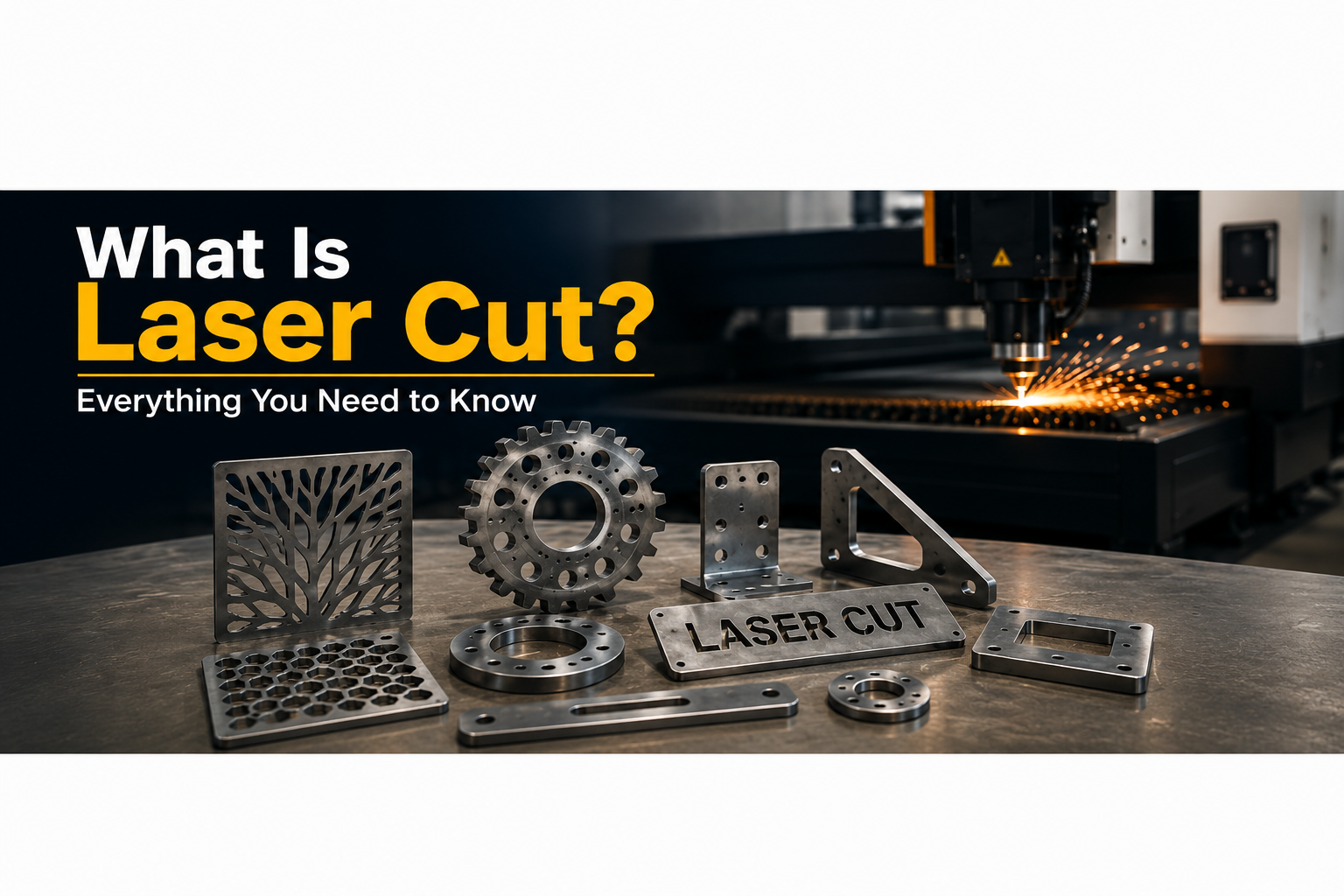
What is laser cut? It is a CNC-controlled process using a focused light beam to cut metal with precision, clean edges, and consistent repeatability. This guide covers what it is, what it does well, its limits, and whether it suits your job.
What Is Laser Cut? The Core Definition
Laser cutting is a thermal, non-contact cutting process. A high-intensity beam focuses to a fine point on the material surface, generating heat that melts or vaporises the material along a programmed path. An assist gas clears molten material from the cut channel, leaving a precise, clean edge.
The key distinction is non-contact. The beam never physically touches the workpiece, which means:
- No tool wear degrading cut quality over time
- No mechanical force distorting or warping thin material
- No vibration affecting edge quality on intricate shapes
- Consistent results from the first part to the last
A CNC system reads the digital file and drives the cutting head along exact programmed paths. This is what makes laser cutting repeatable at a level that mechanical cutting methods cannot match.
What Is Laser Cutting Used For? Real-World Applications
Laser cutting is used wherever precision, clean edges, and repeatable accuracy matter. Across Australia, the most common industrial applications include:
Construction and Structural Fabrication
Base plates, brackets, lintels, connection hardware, and custom fixings for commercial and residential builds. Parts fit together correctly first time, reducing on-site rework.
Engineering and Manufacturing
Precision components, machinery parts, and production hardware where accuracy and repeatability are non-negotiable. A part cut to ±0.1mm today matches a repeat order six months later.
Mining and Heavy Industry
Wear plates (AR400, Hardox), structural components, and replacement parts for high-stress mining and earthmoving environments.
Agriculture
Replacement parts, implement components, and irrigation brackets cut from sketches, photos, or worn originals brought in for duplication.
Marine and Coastal
316 stainless fittings and structural parts for boats and coastal infrastructure where corrosion resistance is critical.
Architecture and Design
Decorative screens, balustrade infills, feature panels, and custom architectural metalwork for residential and commercial projects.
What laser cutting is NOT ideal for:
- Material thicker than 20 to 25mm (plasma is faster and cheaper here)
- Heat-sensitive materials where zero HAZ is required (use waterjet)
- Non-conductive materials like stone or glass (waterjet is better)
What Is Laser Cut Metal? Materials and What to Expect
For industrial and engineering applications, laser cutting is almost always applied to metal. Here is what to expect per material:
Mild Steel
Most common material. Cuts efficiently up to 20mm. Produces clean, weld-ready edges without secondary grinding. Cost-effective baseline for most fabrication work.
Stainless Steel
Requires nitrogen assist gas to prevent edge oxidation, critical for 316 grade. Used extensively in marine, food processing, and coastal applications across Queensland.
Aluminium
Highly reflective but handled well by fibre laser. The 5052 alloy suits general fabrication and 6061 suits structural engineering components. Nitrogen assist gas standard.
Galvanised Steel and Zincalume
Common in outdoor and rural Queensland applications where corrosion protection is built into the base material.
Wear-Resistant Grades
AR400 and Hardox for mining and heavy industry where surface hardness is the priority.
| Material | Key Grade | Max Thickness | Application |
| Mild Steel | MS250, MS350 | Up to 20mm | Structural, general fabrication |
| Stainless Steel | 304, 316 | Up to 12mm | Marine, coastal, food processing |
| Aluminium | 5052, 6061 | Up to 10mm | Engineering, architectural |
| Galvanised / Zincalume | G300, G550 | Up to 3mm | Outdoor, rural, agricultural |
| Wear Plate | AR400, Hardox | Up to 20mm | Mining, earthmoving |
Types of Laser Cutting Machines: What Is the Difference?
For industrial metal cutting in Australia, two laser types matter:
Fibre Laser
The current industry standard for all metal cutting. Generates the beam through semiconductor diodes and a fibre-optic cable, producing a wavelength of around 1 micron that metals absorb efficiently. Faster, more energy-efficient, and better on reflective metals than CO2. This is the technology Absolute Laser Cutting operates from its Arundel facility, handling mild steel to 20mm, stainless to 12mm, and aluminium to 10mm.
CO2 Laser
The previous standard, still found in some shops. Generates the beam through an energised gas mixture via mirrors. Handles non-metals like acrylic and MDF well, but slower on metals. Being progressively replaced by fibre laser in industrial settings.
| Factor | Fibre Laser | CO2 Laser |
| Best material | All metals | Non-metals, thin metals |
| Speed on steel | Faster | Slower |
| Reflective metals | Handles well | Struggles |
| Energy efficiency | Up to 50% | Around 20% |
| Maintenance | Lower | Higher |
| Industry direction | Growing | Declining for metals |
For anyone sourcing industrial metal laser cutting in Australia, fibre laser is the technology to ask for.
Benefits of Laser Cutting Over Other Methods
Here is why laser cutting is the preferred process for precision metal fabrication across Australia:
Precision that holds across a full production run
±0.1mm dimensional tolerance consistently, not just the first piece but every part in the batch.
Clean edges with no secondary finishing
Weld-ready edges straight off the machine. No grinding, deburring, or cleanup required on standard cuts.
Minimal heat-affected zone
The focused beam limits heat input to a narrow band either side of the cut. Material properties are preserved much closer to the cut edge than plasma allows.
Complex geometry without extra tooling cost
Intricate shapes, small holes, and tight radii cost no more to programme than a simple rectangle.
Speed and material efficiency at scale
Nesting software packs parts tightly on the sheet, reducing waste and keeping cost per part competitive on production runs.
| Benefit | What It Means in Practice |
| ±0.1mm tolerance | Parts fit together correctly first time |
| Weld-ready edges | No secondary grinding or deburring |
| Minimal HAZ | Material properties preserved at cut edge |
| Complex geometry | No extra tooling cost for intricate shapes |
| Fast production | Efficient on thin to mid-gauge metals |
| Repeatable accuracy | Every part matches, every time |
Laser Cutting vs Plasma vs Waterjet: What Is the Right Process?
Choosing what is laser cut versus another method comes down to material, thickness, tolerance, and application.
| Factor | Laser Cutting | Plasma Cutting | Waterjet Cutting |
| Tolerance | ±0.1mm | ±0.5 to 1mm | ±0.1 to 0.2mm |
| Edge quality | Clean, weld-ready | Rough, needs cleanup | Clean, no HAZ |
| Heat-affected zone | Minimal | Significant | None |
| Max thickness (steel) | Up to 20mm | 50mm+ | 100mm+ |
| Speed on thin metal | Very fast | Fast | Slow |
| Best for | Precision, production runs | Thick plate | Heat-sensitive materials |
Choose laser cutting when:
- Tight tolerances and weld-ready edges are required
- Material is steel, stainless, or aluminium up to 20mm
- Job involves complex shapes, fine detail, or small holes
- Consistent repeatability across a production run matters
When to Choose Plasma Cutting
- Cutting very thick plate above 20mm
- Tolerance and edge quality are secondary to speed
Choose waterjet when:
- Material is heat-sensitive and zero HAZ is required
- Cutting stone, glass, or composites beyond laser capability
What File Do You Need for Laser Cutting? A Practical Buyer Guide
Most competitor guides skip this section. It is genuinely the most useful thing to know before placing a job.
Preferred file formats:
- DXF or DWG — CNC standard, vector-based, directly machine-readable
- PDF with dimensions — converted to DXF by services with in-house CAD support
- Sketches or photos — accepted at <u>Absolute Laser Cutting</u>, converted at no extra charge
What to include with your file:
- Material type and grade (e.g. 316 stainless, 6061 aluminium, MS350)
- Material thickness
- Quantity required
- Finishing requirements (bending, deburring, coating)
- Required turnaround (standard or express)
The more complete this information is upfront, the faster and more accurate your quote will be. At Absolute Laser Cutting, jobs submitted before 2pm with material details receive a same-day itemised quote with no hidden charges.
What Is Laser Cut Quality? What to Expect from a Good Service
Not every laser cutting service delivers the same result. Here is what quality looks like when done correctly:
Edge quality
Clean, smooth edges with no burr or slag. Ready to weld, paint, or assemble directly off the machine.
Dimensional accuracy
±0.1mm tolerance held consistently across the full production run, not just the first part.
Cut consistency
Part 1 and part 500 from the same file are dimensionally identical. Critical for production runs and repeat orders.
Material integrity
Minimal heat-affected zone. No warping, distortion, or discolouration beyond the cut path on correctly set-up jobs.
Turnaround reliability
Standard turnaround at Absolute Laser Cutting is 3 to 4 business days, with confirmed 24-hour express for urgent jobs.
Common Questions and Important Answer
What is laser cut and how is it different from other methods?
Laser cutting uses a focused beam to melt or vaporise material along a programmed path, producing tighter tolerances, cleaner edges, and a smaller heat-affected zone than plasma or mechanical cutting.
What is laser cutting used for in Australia?
Construction, engineering, mining, agriculture, marine, and architectural fabrication. It is the standard precision sheet metal cutting process across Queensland and Australia.
What materials can be laser cut?
Mild steel, stainless steel (304 and 316), aluminium (5052 and 6061), galvanised steel, Zincalume, AR400, and Hardox. Some systems also cut acrylic and MDF.
What tolerance should I expect from precision laser cutting?
A well-maintained industrial fibre laser holds ±0.1mm consistently across a full production run, making it the most accurate flat sheet metal cutting process available.
Do I need a DXF file to get a laser cutting quote?
No. Absolute Laser Cutting accepts PDFs, sketches, and photos, converting them to cut-ready files at no extra charge for standard preparation.
What is custom laser cutting?
Cutting one-off or bespoke parts to a specific design. Covers single prototype parts through to full production runs of complex custom components.
Now You Know What Is Laser Cut. Get Yours Done Right.
<u>Absolute Laser Cutting has delivered precision laser cutting services from Arundel, Gold Coast since 2010. Industrial CNC fibre laser equipment, ±0.1mm tolerance, same-day quotes, confirmed 24-hour express, and an in-house CAD team working from DXF files, PDFs, sketches, or photos. No minimum order stress. No surprises at invoice.
